• Skip to main content

Townhouse Spitalfields

Vintage, gallery, coffee and cake

  • Home
  • Events
  • Contact

fiona

Life and Death in Spitalfields, originally published 17th February 2013

April 9, 2020 By fiona

Until about 1830 Fournier Street in Spitalfields was called Church Street and in a spare moment last year I googled my address as it was then: 30 Church Street. To my surprise a result from a trade directory was first on the list, referring to Richard Ball, weaver, living here in 1794, and a resident of the building previously unknown to me. Unable to find any further information on him, I filed it away as another piece in the jigsaw of who has lived here for the past three centuries.

In an extraordinary coincidence a few months later I picked up a second-hand copy of ‘Life and Death in Spitalfields 1700 to 1850’ written about the excavation of the crypt in Christ Church and published in 1996. One of the vaults examined was the Ball family, specifically Mary and Martha who died in 1819 and 1821, aged 47 and 70 respectively – but no Richard. I assume, however, that these were his wife and daughter. I have since discovered that Richard Ball seems to have been in partnership with Stephen Sorel, forming the firm Sorel and Ball, weavers and silk merchants of Church Street, which was active c1770 – 1790.

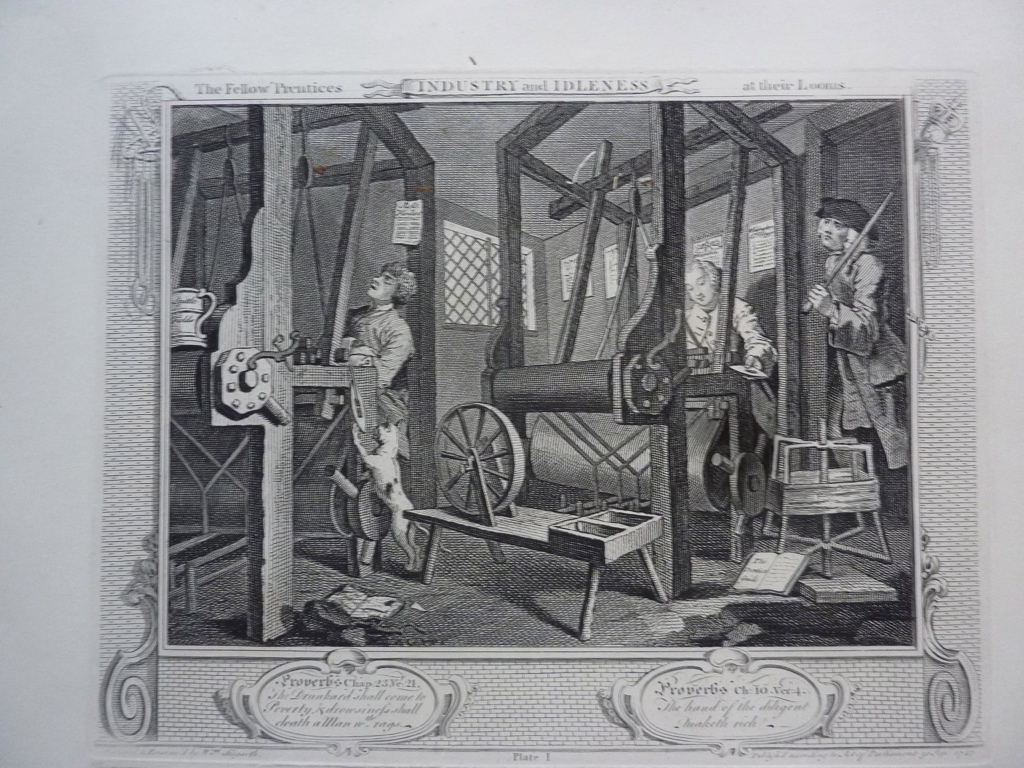
So I am very much looking forward to the talk taking place on the 16th April in Christ Church on these excavations, part of the Huguenots of Spitalfields festival (8th – 21st April). Not that I think the Ball family will feature, but I’ll know a bit more about their lives in Spitalfields as I imagine them weaving in the attic here. The photo is one of the plates from Hogarth’s Industry and Idleness, 1746 and shows weavers with their tall looms, the cut-out for which was found during the work that took place here ten years ago and which survives to this day in the attic ceiling.

Filed Under: Blog

A Cabinet of Curiosities, originally published 28th June 2012

April 8, 2020 By fiona

This is a cabinet of curiosities that isn’t. It is a bookcase into which I placed some smaller items of stock when I was moving things around for the arrival of the coffee machine earlier this year. Small objects, more self-consciously curiosities, had been in it previously and sold, but this time I was in a hurry and in need of somewhere to put things. So instead of selecting and arranging carefully I just put the things in: all have been moved around several times for various reasons, each time in a hurry. Yet the odd thing is that it doesn’t seem to make a difference to how people view the cabinet, mostly finding it fascinating, which has made me wonder why.

Placing the objects in a cabinet seems to take them out of context and makes us look at them in a new way, as though in a museum. There are some animal or mineral curiosities in there, but most are man-made and when I look at the photograph many are, to our modern eyes, slightly curious: a tea brick made for transport by sea, a pocket globe for carrying around, an unusual money box or a snuff box. Rather than being curiosities of a strange new world these are curious because they belong to a past world that is completely unfamiliar, rather like looking at an old faded photograph that initially looks recognisable and then being surprised at how much has changed.

In the past these cabinets were created to display to their audience wondrous man-made or natural objects of a world that was still being discovered. Now, perhaps, the wonder in looking at this lies in how much we have changed.


Filed Under: Blog

Cupcake Day, originally published 6th March 2012

April 7, 2020 By fiona

Saturday was cupcake day in the shop. We gathered at 10.30 to be taught how to decorate them by Lisa who has a passion for making them and baking in general. She supports the Spitalfields Crypt Trust and we offered a donation to the charity in return for a day’s tuition in cake decorating.  I have a collection of 18th and 19th century hand written recipe books, which we are going to use to make the cakes to serve with the coffee arriving downstairs in the kitchen area of the shop in about a month. Cup cakes seem like a good idea too: there is something irresistible about these brightly coloured jewels. In the space of three and a half hours we made and decorated nearly two hundred of them and if you had told me at the beginning that we would be able to decorate the cakes that are in the photo I would have laughed and told you that it would be completely impossible. Nevertheless there they are and they created quite a stir as they appeared in the window of the shop so that by 2pm we had a queue forming and by 5pm we had sold out and raised nearly £200 for the charity. Thank you if you bought one and thanks to Lisa, we had a lot of fun.


(Seems a long while ago now and we never did do cupcakes in the coffee shop, which finally opened in May 2012 after a delay getting the coffee machine).

Filed Under: Blog

Robert Sayer’s Skaters, originally published 4th February 2012

April 6, 2020 By fiona

As I sit here in the shop in the cold waiting for the snow to arrive Robert Sayer’s engraving of skaters in January seemed appropriate.

The figures in this are very appealing: the bulk of the figures are around the fire, so bundled up that they can hardly move in contrast to the lightly clad figures on the ice, keeping warm through exercise. But perhaps he is also illustrating the folly of youth in its refusal to dress up warmly. I am not a print dealer, but from the research I have done into Robert Sayer, these figures seem to be typical. Slightly elongated limbs, with quite distinctive faces and a sparse approach to the landscape setting which has a very linear/graphic feel to it. The lines underneath read:

‘The old ones, round the fire give sage advice,

And cry ‘tis dang’rous skaiting on the Ice’,

But Fribble heeds not what old people say

Because he thinks he’s got more wit than they.’

‘Fribble’ means a coxcomb or dandy and I assume that’s the figure being pushed in the chair on the ice as he looks rather elegantly dressed. Apparently David Garrick played a character of the same name in a play, which fits with a date of mid eighteenth century for this set of prints.

Filed Under: Blog

Le Mans Brocante (originally posted 26th February 2012)

April 5, 2020 By fiona

I set off early on Wednesday morning: up at 5am in France (4am as far as I was concerned), to go with friends to the ‘brocante’ at Le Mans. I hadn’t been to it for a long while– it’s not much fun going on your own, struggling up at that time of the morning, driving for an hour and a half and then fighting for a parking space in the middle of a muddy field, so I was looking forward to going with the others. Of course once we arrived and had a quick cup of espresso to warm up, it was down to work and then you’re on your own: unspoken etiquette demands that you separate and go your own way to avoid the difficulties of everyone wanting the same thing. So it’s first come first served until the initial rush is over and then everyone meets up for another coffee and to compare notes.

I’m told that I’m very fussy about what I buy…. and there were lots of attractive things which, on the whole, weren’t as outrageously priced as I had expected. But it always has to be something I love for one reason or another and this dish from Provence was one of them. Partly it is the shape: I have two plates in the shop at the moment with the same glaze, so I was pleased to find a serving dish. Then there is the colour: such a suggestion of summer warmth against which any food would look good. But one food sprang to mind as soon as I saw it – asparagus. It’s not only that English asparagus is delicious, but the fact that it is only around for such a short time heightens my anticipation. And it is soon followed by broad beans, peas and all the other harbingers of summer. More than anything else though, it is the fact that asparagus would look perfect against the warm yellow of this glaze.


Filed Under: Blog

Eleanor Crow’s Shopfronts of London

September 27, 2019 By fiona

An exhibition to accompany publication of the book of the same name featuring over eighty of Eleanor’s watercolours from the book, including some new ones

At a time of momentous change in the high street, Eleanor’s witty and fascinating personal survey champions the enduring culture of Britain’s small neighbourhood shops. Eleanor’s collection includes eighty of her watercolours of the capital’s bakers, cafés, butchers, fishmongers, greengrocers, chemists, launderettes, hardware stores, eel & pie shops, bookshops and stationers. Her pictures are accompanied in the book by the stories of the shops, their history and their shopkeepers – stretching from Chelsea in the west to Bethnal Green and Walthamstow in the east.

The watercolours are £150 framed (A5) and larger ones are £210 framed.

The exhibition opens on the 3rd October with a book launch and signing that evening 6 – 8pm and the exhibition continues at Town House until Sunday 20th October.

Filed Under: Exhibitions, Gallery, Paintings

A Botanist takes to Paint

May 2, 2019 By fiona

I first came encountered David Stuart as a writer on garden history many years ago and was delighted to discover last year that he has now taken to paint . As a result I’m happy to announce that the summer exhibition at Town House shows recent work by David – botanist, author and now artist. Much of his work uses plants as a central motif and though treated with great expression, all are based on an intense knowledge of plant design and an equally intense love of their beauty.

David has always loved plants. After frequent painting trips to Kew Gardens as a child, he became a botanist studying plant structure and relationships and has a PhD from Edinburgh University, working at the Royal Botanic Garden. Thereafter, he spent many years as a writer and journalist specialising in gardens, garden history, plants and their influence on all our lives.

He has had columns in national newspapers and has published fifteen books, many hugely well reviewed. They include Georgian Gardens, Plants that Shaped our Gardens, Dangerous Garden, and Classic Garden Plans. Recently though, he has returned to painting and print making.

Exhibition runs at Town House 18th May – 8th September

Three Cans

Filed Under: Uncategorized

Maps of London and Beyond by Adam Dant

July 1, 2018 By fiona

An exhibition of some of Adam Dant’s maps giving his unique view of our history and life today, to accompany publication of the book of the same name published by Batsford in conjunction with Spitalfields Life.

Artist and cartographer Adam Dant surveys London’s past, present and future from his studio in the East End. Beautiful, witty and subversive, his astonishing maps offer a compelling view of history, lore, language and life in the capital and beyond. Traversed by a plethora of colourful characters including William Shakespeare, Charles Dickens, Mary Wollstonecraft and Barbara Windsor, Adam Dant’s maps extend from the shipwrecks on the bed of the Thames to the stars in the sky over Soho. Along the way, he captures all the rich traditions in the capital, from brawls and buried treasure to gin and gentlemen’s clubs.

Adam Dant studied at the Royal College of Art, London and the MS University Faculty of Fine Arts, Baroda, India. He creates elaborate narrative drawings that examine and depict public contemporary life, space, mythologies and histories. Extensively researched and wittily perceptive, these works of art draw on a deep well of historical and visual sources. Adam Dant was the official election artist in 2015 and he lives and works in London.

Exhibition runs 5th – 22nd July 2018 at Town House

Maps of London and Beyond
Maps of London and Beyond by Adam Dant


Filed Under: Uncategorized

  • « Go to Previous Page
  • Page 1
  • Page 2
  • Page 3
  • Page 4
  • Page 5
  • Page 6
  • Interim pages omitted …
  • Page 10
  • Go to Next Page »
Copyright 2020 · Townhouse, 5 Fournier Street, Spitalfields, London, E1 6QE · Telephone: +44 20 7247 4745